STATES AND UNION TERRITORIES OF INDIA
RAJASTHAN
Chittorgarh
Chittorgarh
or Chittor was the capital of the Sisodia clans of Rajput and of Mewar.
A fiercely independent, the fort was under siege thrice and each time they
fought bravely & thrice jauhar was committed by the ladies and children.
The first attack
was by Alauddin Khilji in 1303 AD, who was enamoured by the beauty of Padmini
of which he had only heard. Rani Padmini preferred death to abduction
and dishonour and committed jauhar along with the other ladies. The
second attack was in 1535 by Sultan Bahadur Shah of Gujarat on Bikramjeet.
Before Humayun's troupe could come & defeat the Shah, Rani Karmavathi
committed jauhar along with the other women and the Rajmata had died in
the battlefield. The third instance was in 1567 when Akbar attacked
during the time of Maharana Udai Singh. This final attack was complete
when the army looted and destroyed all the buildings. The Mewars
were forced to shift their capital to Udaipur. Chittor stands for
the heroism, chivalry, valour and sacrifice, all inbuilt characteristics
of Rajputs.
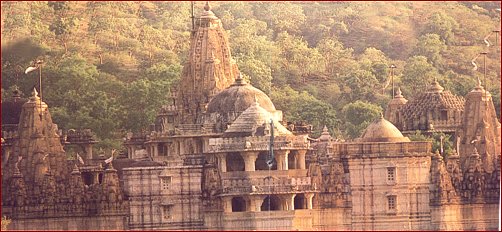
The Chittor
fort seated on a 180 metre hill, covers an expanse of 700 acres.
It was constructed by the Mauryans in the 7th century AD. There is
also a belief that it was constructed by Bhima of the Pancha Pandavas.
This fort was the citadel of many great Rajput warriors such as Rana Kumbha,
Maharana Pratap, Jaimal, Patta, etc.
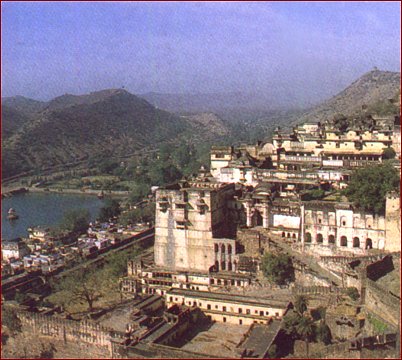
There are seven
gates before reaching the fort. They are the Padan Pol, Bhairon Pol, Hanuman
Pol, Ganesh Pol, Jodla Pol, Laxman Pol and Ram Pol. Padal Pol is
a gate where prince Bagh Singh died during the second attack. The
Chattris of the young prince Jaimal of Badnore and his clansman Kalla are
located between the Bhairon Pol and Hanuman Pol, marking the spots where
they were killed by Akbar in 1567. Near the Ram Pol which is the
final gate, is the Chattri of 15 year old Patta of Kelwa who fought bravely
to the end.
Vijay
Stambh
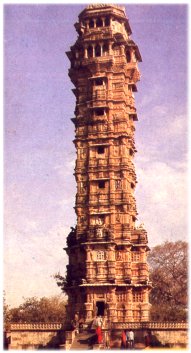
Vijay
Stambh is a huge nine
storey tower which was built by Maharana Kumbha to commemorate his victory
over the Muslim rulers of Malwa and Gujarat in 1440. The tower is
122 ft high and stands on a 10 ft high base. There are sculptures
and carvings on the exterior walls of the tower. The
tower is visible from any section of the town below. And from the
tower top after climbing 157 steps, there is a great view of the surroundings.
The inside walls of the tower are carved with images of Gods, weapons,
etc.
Kirti
Stambh
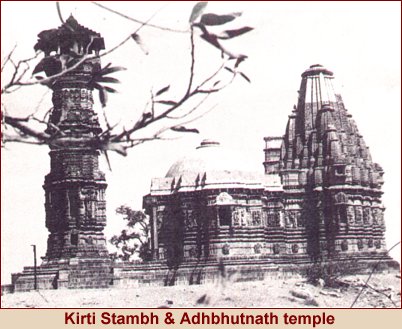
Kirti Stambh is dedicated to
Adinathji, the first of the Jain Thirthakaras. It was built by a
merchant and is decorated with figures form the Jain pantheon.
Rana
Kumbha's Palace
is near the Vijay
Stambh. This is the birthplace of Maharana Udai Singh the founder
of Udaipur. His life was saved by the heroic act of the maid Panna
Dhay, who replaced her son in place of the prince & consequently her
son was killed by Banbir. She carried the prince away to safety in
a fruit basket. Rani Meera Bai also lived in this palace. This
is the place where Rani Padmini committed jauhar with the other ladies
in one of the underground cellars.
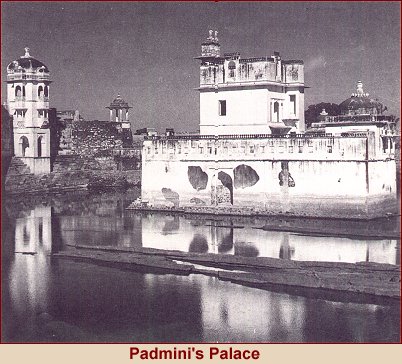
Padmini's Palace
This is the palace
from which Alauddin was allowed to watch a reflection of the Rani.
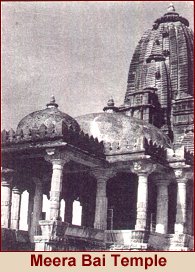
There is a temple
for Meera Bai, the wife of Bhojraj,
who was known for her great devotion to Lord Krishna & also for her
great bhajans.
 Kalika
Mata Temple
Kalika
Mata Temple
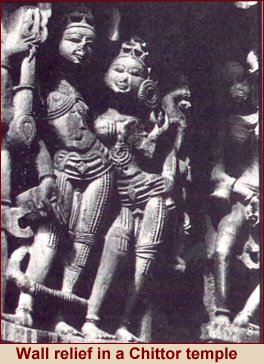
The Government
Museum is located at the Fateh Prakash Palace and displays a collection
of sculptures and other artefacts. Other places of interest are the
Pratap and Nehru Parks.
|