Musings on Music
a handy music diary for writing notation by S.Rajam
Text by S.Rajam, Text assisted by "Garland" Rajagopalan, Illustration by S.Rajam
Origin & Classification
Sage Bharata defines 'Music' as
the confluence or combination of Swara, Tala, & Pada - all in harmonious
blend. Sage Matanga defines 'Raga' as a combination of musical notes that
gives delight. a melody arrangement to project a definite mood, emotion
or feeling.
Brahma was the origin of music inspired
by Sama Veda. From one note, music progressed to three, then five &
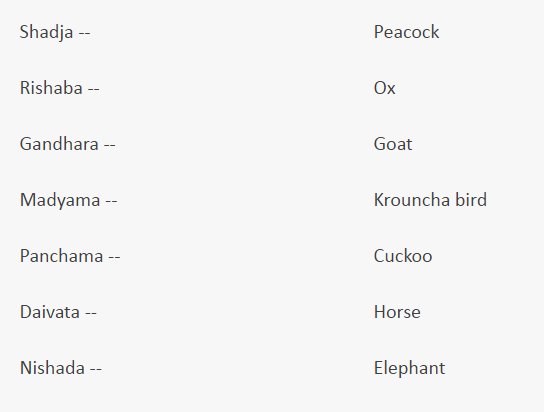
crystallized in seven notes, the Sapta Swaras. Sapta Swaras are Shadja,
Rishaba, Gandhara, Madyama, Panchama, Daivata & Nishada. Swara is a
musical note. Swaras are reputed to have been inspired by sounds of birds
& animals such as :
Indian music has fundamentally been
a spiritual aid & the vehicle for the soul to realise & attain
the Universal Soul ( Paramatman). It lay stress on melody, harmony being
secondary though vital.
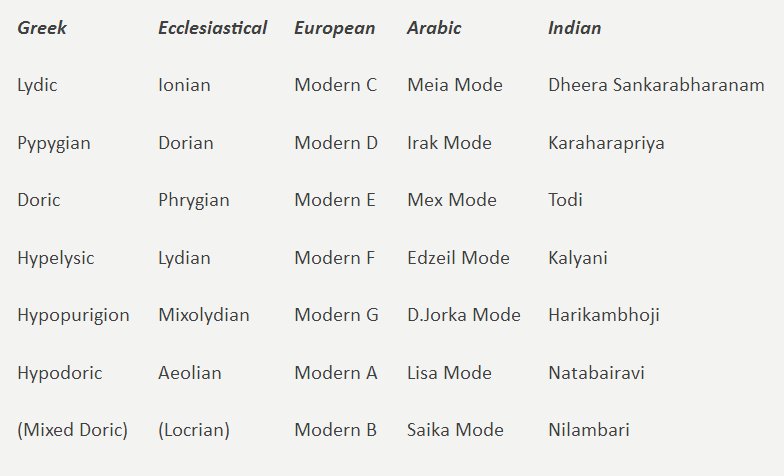
Corresponding Classification/Nomenclature
:
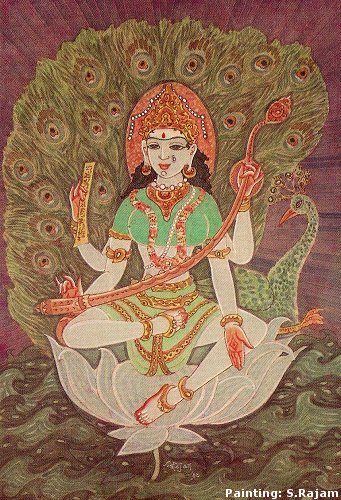 Saraswathi-the Goddess of Fine
Arts (Painting as found in Nepal)
Saraswathi-the Goddess of Fine
Arts (Painting as found in Nepal)
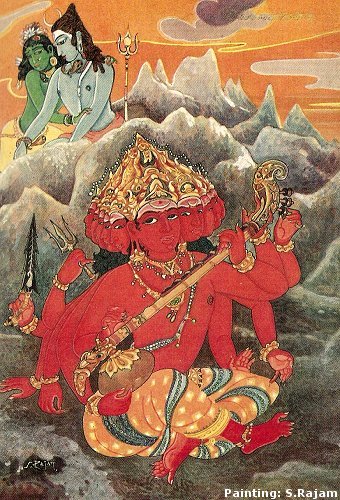 Ravana disturbed Siva &
Parvathi, while lifting Kailas and got entangled.
Ravana disturbed Siva &
Parvathi, while lifting Kailas and got entangled.
Ravana with his
veena sings "SAMAGANAM" to get release from the pressure of Mount Kailas
over him.
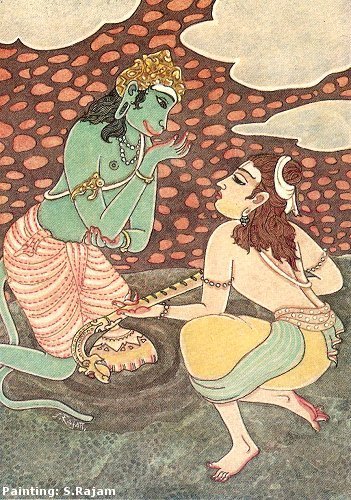 Sage Narada's vanity in music
is subdued by Anjaneya.
Sage Narada's vanity in music
is subdued by Anjaneya.
Narada's main musical overtures failed, but
Anjaneya's oneness with music melted the surroundings and the veena got
stuck.
|
Scale means stepwise
arrangement of notes which when successively invoked develop & provide
melody. Shadjam is basic or adhara swara which is the basis for the other
six notes. Madyama is pitchforked between two traids. Panchama denotes
the fifth place. When Sama Veda was recited ( Sama ganam), the spouse accompanied
on veena or flute.
From Pranavam emanates Satyajatam,
Vaamanam, Tatpurusham, Eesanam & Aghoram which are the five faces of
Lord Siva, from which the musical notes emanated & passed on to Posterity.
Siva taught Parvati, the prime Sishya & it was successively passed
on to Tumburu, Narada, Nandikeswara & Saraswati.
Initial instruments were :
Damaru of Siva, Flute of Krishna,
Conch of Vishnu, Drum of Nandi, Veena of Saraswati & Narada, Thambur
of Thumburu. Lord Buddha reinvigorated his teachings & message with
music on his Parivadini veena, made of gold, having 21 strings.
Sama Veda is well-known as musically
rendered. Rig Veda too is reputed to have been chanted once musically.
Thevaram by Appar, Sundarar & Sambandar and Divya Prabandam by Vaishnavite
Azhwars came up during 7-9th centuries. |
From Musings on Music - a handy
music diary for writing notation by S.Rajam
Text by S.Rajam, Text assisted
by "Garland" Rajagopalan, Illustration by S.Rajam
|