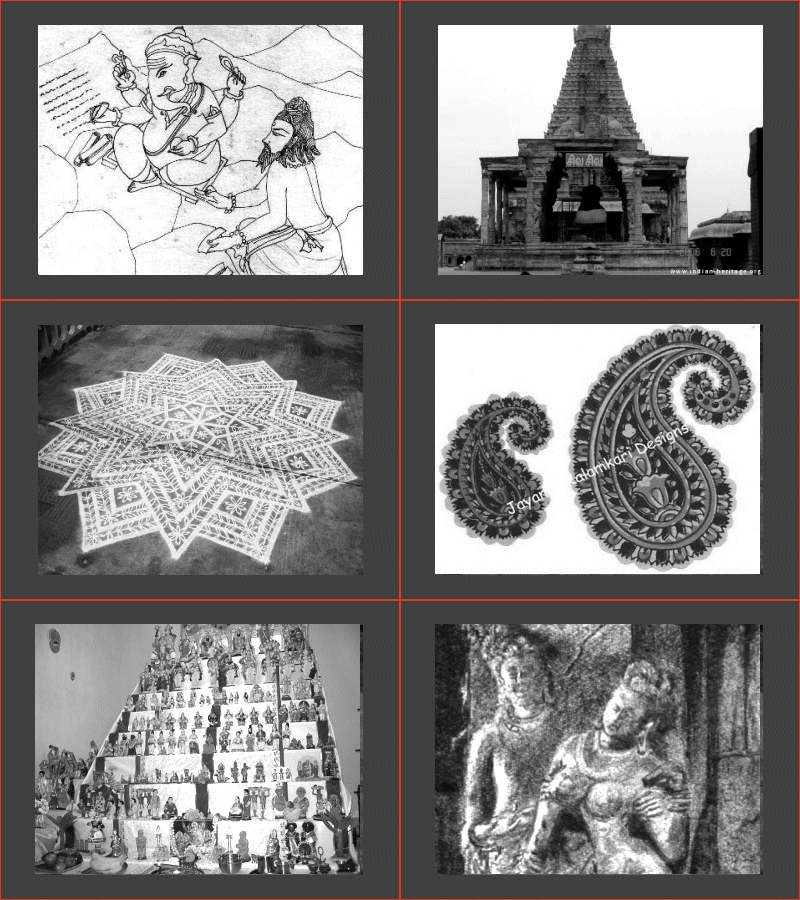
Goddess Sakthi
is worhipped on the first three days, Goddess Lakshmi on the 2nd three
days & Goddess Saraswathi on the last three days. The 10th day
is celebrated as Vijayadasami. (Vijaya means victory). Prayers and
pooja are offered to the Goddess on all 10 days in temples and households.
Chakkarapongal, payasam, vadai, sundal are the traditional offerings
to the Goddess during Navarathiri. The 9th day is celebrated as
"Saraswathi
Pooja" or
"Ayudha Pooja". The place is cleaned and all
books, tools, art, craft materials are placed in front of the Goddess for
her blessing. In factories and companies, all the machineries, tools
and account books are placed in the pooja before the Goddess. The
next day on
"Vijayadasami", work is commenced, new ventures started,
children are admitted to school or art classes. Students offer their
respect & thanks to their teachers / gurus.
In the temples,
special pooja is offered and the Goddess (urchava murti) is decorated differently
each day and taken in procession. Music and dance events, discourses,
etc are organised in temples and sabhas.
The Dussera
function is very famous in Mysore and Kolkatta.
In Tamilnadu,
another popular aspect of Navarathri is the
"GOLU". This
is the display of dolls, idols, kolams in steps (usually an odd no. of
5, 7, 9) depending on aailability of space. Mniature settings of parks,
temples, scenes is very popular with the children in the family.
Friends and neighbours are invited. Visitors often sing a song or
recite slokams. They are given thamboolam (vethalai paaku, manjal,
coconut or fruits like orange, apple, banana) and the sundal of the day
and perhaps some small gift item.
On Vijayadasami
day the golu is removed or atleast some of the dolls are laid flat to show
the display is over.
I have provided a gallery of golus at the Parthasarathy
temple and a few homes.
Deities to be worhipped on the 10 days - pooja, slokam for each day
(Source: Navarathri by Nirajana.S, superduper-kitchen.com, 24 Sep 2019 )
Navarathri Day 1
Devi: Maaheswari
Flower: Malligai
Neivedhyam: Ven pongal
Thithi: Pradhamai
Kolam: Arisi maavu (rice flour) pottu kolam. (Rangoli by using rice flour.)
Raagam: Thodi Raagam
Slokam: Om swethavarnaayai vidhmahe
soola hasthaayai dheemahi
thanno Maaheshwari Prachodayaath
Navarathri Day 2
Devi: Kowmaari
Flower: Sevvarali
Neivedhyam: Puliyodharai
Thithi: Dwitheeyai
Kolam: Maa kolam. (Rangoli by using wet flour.)
Raagam: Kalyaani
Slokam: Om Siki vaahanaaya vidhmahe
Sakthi Hasthaayai Dheemahi
Thanno kowmaari Prachodayaath
Navarathri Day 3
Devi: Vaaraahi
Flower: Champangi
Neivedhyam: Sakkarai pongal
Thithi: Thrutheeyai
Kolam: Malar/Poo kolam. (Rangoli by using flowers)
Raagam:kaambhodhi
Slokam: Om Magishathvajaaya vidhmahe
Thanda Hasthaaya Dheemahi
Thanno Vaaraahi Prachodayaath
Navarathri Day 4
Devi: Lakshmi
Flower: Jaathi Malli
Neivedhyam: Kadhamba Saadham
Thithi: Chathurthi
Kolam: padikattu kolam with Atchadhai (Rangoli in
shape of steps by using atchatai (mix of rice, turmeric, ghee.)
Raagam: Bhairavi
Slokam: Om Padma Vaasinyai cha Vidhmahe
Padmalochanee sa Dheemahi
Thanno Lakshmi prachodayaath
Navarathri Day 5
Devi: Vaishnavi
Flower: Paarijaatham & Mullai
Neivedhyam: Curd Rice
Thithi: Panchami
Kolam: paravai kolam using Kadalai maavu (Rangoli with bird designs using Bengal gram flour.)
Raagam: Bandhuvaraali Panchamaavaranai keerthanai.
Slokam: Om Syaamavarnaayai Vidhmahe
Chakra Hasthaayai Dheemahi
Thanno Vaishnavi Prachodayaath
Navarathri Day 6
Devi: Indraani
Flower: Semparuthi
Neivedhyam: Coconut rice
Thithi: Sashti
Kolam: Devi naamam using Kadalai maavu (Name of the goddess using Bengal gram flour.)
Raagam: Neelaambari
Slokam: Om Kajathvajaayai vidhmahe
Vajra Hasthaaya Dheemahi
Thanno Iyndree Prachodayaath
Navarathri Day 7
Devi: Saraswathi
Flower: Malligai & Mullai
Neivedhyam: Lemon rice
Thithi: Sapthami
Kolam:Narumana malargal kolam (Rangoli by using fragrant flowers-pookolam.)
Raagam: Bilahari
Slokam: Om Vaakdevyai vidhmahe
Vrinji pathnyai sa Dheemahi
Thanno Vaani Prachodayaath
Navarathri Day 8
Devi: Durga
Flower: Roja
Neivedhyam: Paayasaannam
Thithi: Ashtami
Kolam: Padma kolam (Traditional lotus shaped rangoli)
Raagam: Punnagavaraali
Slokam: Om Magisha mardhinyai vidhmahe
Durga devyai Dheemahi
Thanno Devi Prachodayaath
Navarathri Day 9
Devi: Saamundaa
Flower: Thaamarai
Neivedhyam: Akaaravadisil
Thithi: Navami
Kolam: aayudham shapes using Vaasanai podi (Weapon shaped rangoli using fragrant powder.)
Raagam: Vasantha raagam
Slokam: Om Krishna varnaayai vidhmahe
Soola Hasthaayai Dheemahi
Thanno Saamundaa Prachodayaath
Vijaya dasami
Devi: Vijaya
Flower: Malligai, Roja
Neivedhyam: Sakkarai pongal, sweets
Thithi: Dasami
Slokam: Om Vijayaa devyai vidhmahe
Mahaa Nithyaayai Dheemahi
Thanno DEVI Prachodayaath
|
Golus 2020
Golus 2017
Srirangam Temple Golu - 2017
Photos by Aparna Rajagopalan
Temple Golu arranged by S. Surendranath, S. Amarnath and S. Aparna
(known popularly as 'The Mylapore Trio') and M. Sugathan at the Aayiram
Kaal Mandapam, Srirangam Sri Ranganathaswamy Temple with 35 3-step bays
featuring over 1,000 dolls.
Theme: Bhakthiyum Mukthiyum Srimannarayananey.
Ms.Chandra, Texas, USA
Ms. Gomathy Mohan, USA
Ms. Krithika Iyer, USA
Ms. Lalitha Srinivasan, USA
Golus 2015
Golus 2013
Golus 2012
Golus 2011
Golus 2010
(I am only featuring photographs of golus arranged during the Season. I do not sell dolls.)
Related links
Kolu steps procedure by Niranjana Sankaranarayanan
superduperkitchen.wordpress.com
Artefakt- Nagpur Dolls
Owned by Ramani Yellapantula, ARTEFAKT (Papier-machie artwork)
#NagpurDolls is an initiative undertaken to rekindle the art of doll
making.
Doll shops in Mada veedhis of Mylapore
mylaporetimes.com/2012/

- mylaporetv
Kolu Bommais by Mr. Paramasivam, the artisan behind Mylapore's renowned Jayamaruthi Manual Bommai Kadai
Shops selling dolls online
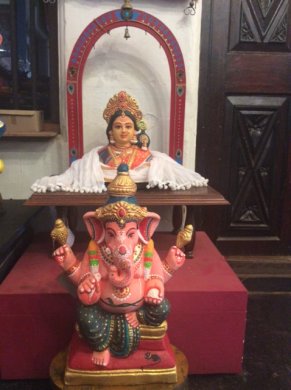
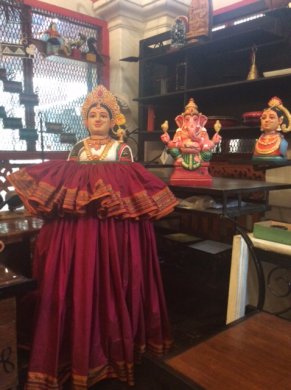
Ganeshas and Gowris fashioned by traditional potters using fully soluble
unbaked river or pond silt - various traditional poses such as
the Peetha Ganesha or the Lotus seated Ganesha or Gowri or the Seyr
Gowri. Each one of the Ganesha and Gowri idols is
individually hand-painted by Deepika of Bimba The Art Ashram. Other
pooja offerings include skilfully handcrafted and vibrantly handpainted
small and large mantaps, peethams (stools), mini thottulus (swings),
colourful vertical and horizontal (festoons) and a wide range of
handmade Vastra (attire) and Aabharana (ornaments).
Deepak and Deepika ( tel 08041489354)
Bimba The Art Ashram 42 Ratna Vilas road Opp Canara Bank DVG rd branch Basavanagudi Bengaluru 560004
artsandhandicrafts.in/
navarathri.com/
|